






Student Zone

Learning Road Signs

26 October 2026 • 3 min read

Learning road signs should involve more than memorising their appearance and recognising symbols. Above all, it should focus on understanding what they mean and how to respond to them in different road situations. Well-organised learning materials should combine an image of each sign with its official name, meaning, and an example of how it is used. In the theory test, it is important to be able to relate a sign to right-of-way rules, permitted manoeuvres, restrictions, or potential hazards.

How to Study Road Signs Effectively?

Effective learning begins with understanding the main categories of road signs and their functions. The next step is to memorise individual signs along with their official names and explanations of their meanings. This should be followed by practising exam questions, which help you check how to apply your knowledge to specific road situations.

Rather than memorising a long list in random order, it is best to review the material by category: warning signs, prohibition signs, mandatory signs, information signs, direction and place identification signs, supplementary signs, and road markings.

Basic and Most Important Road Signs

There is no official category known as “the most important road signs”. When preparing for the theory test, you should learn all applicable signs and understand their meanings. Therefore, it is not advisable to limit your studies to just a few commonly encountered symbols.

Initially, you can focus on signs that directly affect right of way, speed, direction of travel, the ability to perform a manoeuvre, and road safety. This is a good starting point, but learning should not stop at the most commonly encountered symbols.

Road Signs and Their Meanings – How to Avoid Rote Learning

Rather than memorising only the appearance of road signs, focus on understanding their meanings and how they are applied. For each sign, ask yourself three questions: What does it mean? What action does it require, or what information does it provide? How does it affect the road situation shown? This approach helps you understand road sign descriptions and reduces the risk of confusing similar symbols.

Changing Direction of Travel and Road Signs

When changing direction, particular attention should be paid to signs governing right of way, permitted directions of travel, turning restrictions, lane arrangements, and road markings. When answering exam questions about turning or making a U-turn, you should analyse all the signs and the entire road situation rather than looking for a single “most important” sign.

Polecane dla kursantów

News & Updates
October 26, 2026 • 3 min read

17-Year-Olds Behind the Wheel – When Can They Drive Alone and When Must They Be Accompanied?

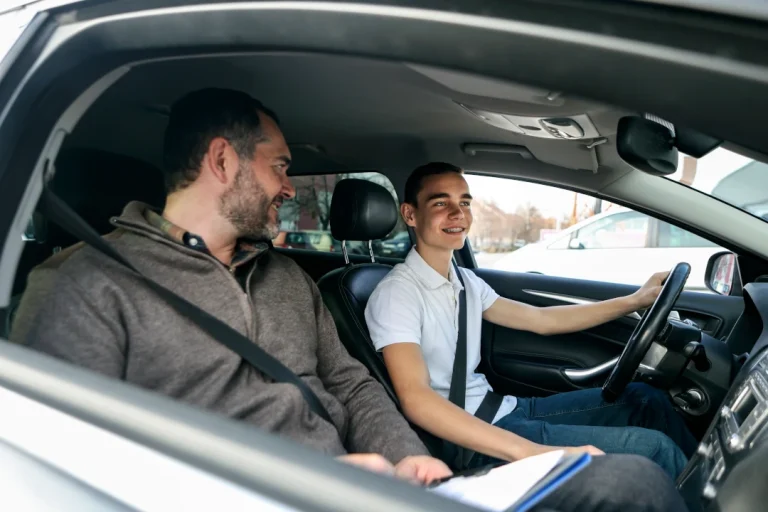
As of 3 March 2026, it is possible to obtain a Category B driving licence at the age of 17, provided that the requirements set out in the relevant regulations are met. However, this does not mean that a 17-year-old can immediately drive a car entirely independently. Obtaining a driving licence before reaching the age of 18 involves additional restrictions on driving alone. The regulations provide for a period during which a young driver must drive in the presence of an accompanying person who meets specific requirements. However, this restriction does not necessarily last for the full six months. The date on which the driver turns 18 is also important.

Student Zone
October 26, 2026 • 3 min read

Your First Driving Test at a WORD Examination Centre – What Happens from Arrival to Receiving Your Result?

The first state driving test can be a source of uncertainty, not only because of the assessment of driving skills itself, but also because candidates may not always know what to expect when visiting a Regional Road Traffic Centre (WORD). What happens after entering the WORD examination centre? How is identity verified? How long does the driving test take, and when can candidates find out their results? It is worth knowing the sequence of the various stages before the scheduled test date.

Frequently Asked Questions (FAQ)

Didn't find your answer? Contact our support team.

Customer Service Office
Partnerships & Driving Schools
Technical Support
Available Monday to Friday 8:00 AM - 4:00 PM
Click the "Register" button in the top right corner of the page, fill out the short form (email, password, driving category), and click the activation link sent to your email.
Didn't find the answer to your question? Go to Help Center →

Follow us on TikTok to stay updated!

Quick tips, intersection analysis, and tested tricks for passing your exam.

Frequently Asked Questions (FAQ)

Didn't find your answer? Contact our support team.

Customer Service Office
Partnerships & Driving Schools
Technical Support
Available Monday to Friday 8:00 AM - 4:00 PM
Click the "Register" button in the top right corner of the page, fill out the short form (email, password, driving category), and click the activation link sent to your email.
Didn't find the answer to your question? Go to Help Center →

Let's stay in touch

Have questions regarding driving courses or driving schools? Contact us.

Wydawnictwo Liwona SmartTesty Publisher

Office

Mon. - Fri. 8:00 AM to 5:00 PM

Liwona sp. z o.o.
ul. Rakuszanki 5, 02-496 Warszawa
NIP: 5222507848

Contact Form

Write to us - we usually reply within a few hours.

Testy na prawo jazdy